Enterprise & multi-site LIMS deployment
Enterprise LIMS, without losing the local workflow.
Plan multi-site and multi-laboratory LIMS: configuration, cloud vs on-premise, hybrid deployment, scalability, high availability and recovery.
What matters in practice?
Enterprise LIMS connects laboratory records, shared master data and authorised access across a wider organisation. The design must also preserve each laboratory’s methods, reporting rules and responsibilities.
Multi-site LIMS and multi-laboratory LIMS
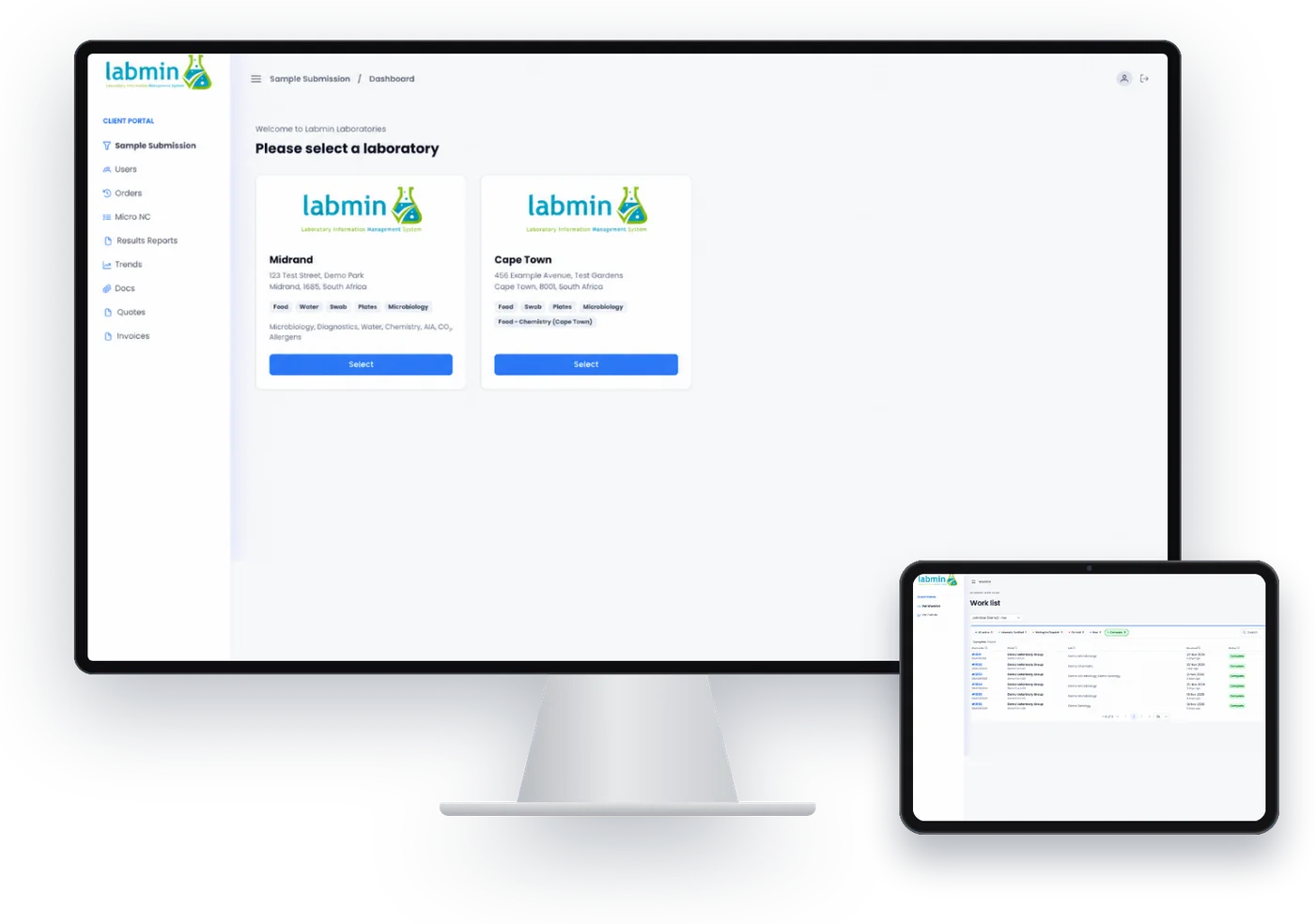
A multi-site laboratory may receive samples in one location and test them in another. A multi-laboratory organisation may also run different disciplines, accreditation scopes and client agreements. Both need a common identity strategy, but they don’t necessarily need identical workflows.
Map the transfer record, receiving acknowledgement, local due dates and responsible reviewers. Agree who owns methods, specifications and client records. Decide which data can be shared centrally and which must stay restricted to a laboratory, project or customer.
Custom LIMS or configurable LIMS?
Configurable LIMS adapts supported workflows, fields, methods, limits, roles and reports. Custom LIMS development introduces new behaviour where configuration can’t satisfy a requirement. Start with configuration and demonstrate the difficult exceptions before agreeing to custom work.
We tailor Labmin around your laboratory workflows. In an enterprise discovery session, bring examples from more than one site so the proposed configuration reflects differences rather than assuming a single process fits everywhere. Document ownership, testing and upgrade support for every custom extension.
Cloud vs on-premise LIMS and hybrid LIMS
A cloud LIMS places the application on hosted infrastructure. An on-premise LIMS runs on infrastructure under the organisation’s control. A hybrid LIMS architecture may combine a hosted application with local instrument gateways or other on-site services; hybrid doesn’t automatically mean offline laboratory operation.
Our LIMS is cloud-based. Confirm any on-premise or hybrid proposal, supported architecture, hosting location, connectivity requirements and support responsibilities with our team before treating it as an available deployment option. Compare the full operating model, not just where the server sits.
LIMS scalability and high availability
Size the environment against concurrent analysts, daily sample intake, results per sample, large instrument files and reporting peaks. A laboratory processing a few large studies has different demands from a laboratory receiving thousands of short routine requests.
High availability LIMS design reduces disruption when a component fails. Ask for the agreed service target, failover arrangement, maintenance windows and evidence of load testing. More sites or users don’t, by themselves, establish an availability guarantee.
LIMS backup, disaster recovery and recovery testing
Backups preserve recoverable data; disaster recovery restores usable laboratory services after a wider incident. Specify the recovery point objective (acceptable data loss) and recovery time objective (acceptable restoration time) for each essential workflow.
Include databases, reports, attachments, instrument exchange queues, configurations and the keys needed to read protected data. Ask who performs restores, how often recovery is tested and how a laboratory continues safely during an outage. A successful backup job isn’t evidence that a full recovery will succeed.
Your planning checklist
Use these points to prepare your team’s discussion. Tick items as you review them; nothing is sent or saved.
Answers before the next step.
Does Labmin offer on-premise or hybrid deployment?
Our LIMS is cloud-based. If you need on-premise or hybrid deployment, we’ll assess the architecture and support requirements with your IT team and confirm the available options.
What should an enterprise LIMS demonstration include?
A sample moving between sites, site-specific access, method ownership, consolidated reporting, exception handling and the proposed recovery arrangements.
Where would you like to go next?
The layers behind a LIMS.
LIMS architecture, cloud and multi-site design, database relationships, instrument gateways and how a LIMS works from request to approved report.
Explore the guide
Security belongs in every laboratory handoff.
LIMS security and cybersecurity evaluation: SSO, Active Directory, Entra ID, MFA, role-based access, encryption, audit logging and penetration testing.
Explore the guide
A LIMS rollout starts with the work, not the software.
LIMS implementation process, timeline, data migration from Excel or legacy LIMS, rollout strategy, user training and an implementation checklist.
Explore the guide